

EGA President and CEO
2026 State of the States Briefing Reflections
Solidarity For People and Planet
Thank you to those who joined us at the 2026 State of the States Briefing in San Francisco, California. Members and new friends gathered to align and advance our shared vision for the future of people and planet.
In California, we explored the rich terrain of ideas about philanthropy’s role in reinforcing a healthy democracy for a healthy planet. Members assessed the strength of portfolio capacity to respond in support of the values we share. We engaged with expert leaders in thoughtful discussions. The gathering solidified our belief than grantmakers can and are staying strong in the face of mounting pressure.
Grounded in EGA’s Racial Equity POV and The Accords on the Future of Environmental Philanthropy the briefing offered space for grantmaker reflection on the practice of funding. Moreover, the group witnessed regional, national, and global commitment to partnership with grantees as a natural extension of community support. The program leverage lessons from federal regression and divestment.
I invite each of us to carry the teaching and exchange beyond the SoS by exploration of our organizations commitment to the calls to action within the Accords and pathways to implementing them. Now is the time for the most privileged to commit to building a more vocal, visible, and united giving community.
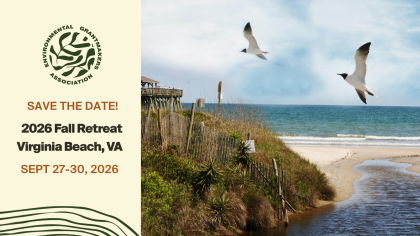
Save the date for our Fall Retreat, September 29-30, 2026, in Virginia Beach, VA, where our membership will gather to collectively respond to today’s challenges and tomorrow’s opportunities. We are privileged to be together to explore how grantmakers are sustaining solidarity in a time of federal encroachment.
EGA remains your partner in the practice of just philanthropy for people and planet. Don’t hesitate to reach out to me or the EGA team with your needs, inquiries, or insights.
Enjoy the recap and resources from the SoS briefing!
Warmly,
Tamara
Tamara Toles O'Laughlin
CEO and President
Environmental Grantmakers Association
“We are in this together, in the fight for democracy” – Sierra Martinez, Senior Program Officer, Climate at Clif Family Foundation.
Grounding the California Convening
EGA convened our State of the States Briefing on the lands of the Ramaytush Ohlone people who are the First Residents and stewards of what is now known as San Francisco, California.
Rhea Suh, President & CEO of the Marin Community Foundation, grounded us for the day’s learnings by setting economic and historical context for the region and calling on philanthropy to rise to the moment and resource capacity on the frontlines.
California has the largest economy of any state. It is one of the most diverse and populated states in the nation. Despite the region's wealth, the cost of living is extremely high, leaving affordability and livability at odds. There are opportunities for philanthropy to work in close proximity to the community and build capacity to address local community needs and environmental policy changes.
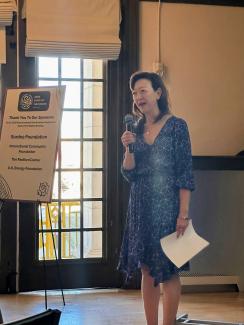
Rhea Suh, President & CEO of the Marin Community Foundation
Takeaways
- Internal alignment: In a shifting political landscape, it is important for CEOs, staff, and boards to be in alignment.
- Look to the Midwest: Midwest funders have figured it out. There’s a long legacy of commitment in the region with reciprocal relationships.
- A moment for grantmakers to advance impact: This is our opportunity to partner with community foundations for impact, and capacity. If we work more locally, we won’t have to wait for the day we see national policy. We’ll see transformation locally and in concentric circles outward.
- Proximal partnership: Partner with folks who are willing to partner with you, now.
Further reading: “How local climate activism leads to ‘remarkable’ gains” Grist
Advancing a healthy Democracy for a Health Planet
Stephanie Goodrid Lawson, Executive Director of the McKinney Family Foundation, and Melanie Allen, Chief Executive Officer of the Hive Fund for Climate and Gender Justice discussed philanthropy's role in advancing a healthy democracy.
Melanie spoke to the room about the ongoing and growing work of the Hive Fund for Climate and Gender Justice. She imparted the myriad ways the South is integral in advancing democracy and how it offers insight on our preparedness for required pivots. The fund can attest that there is no path to durable climate action that does not go through the US South. Similarly, there’s no way to move towards a sustainable democracy without resourcing the south.
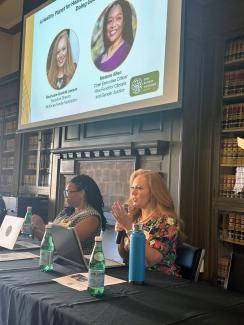
[From left to right]: Melanie Allen, Chief Executive Officer of the Hive Fund for Climate and Gender Justice and Stephanie Goodrid Lawson, Executive Director of the McKinney Family Foundation.
Stephanie shared her insights on the collaborative work being done in the Midwest with and beyond the McKinney Family Foundation. The Midwest hosts a close-knit grantmaking community, often meeting through various conferences and regular calls. The McKinney Foundation counts close ties to community foundations to its enhanced capacity to support practices that make the surrounding community and region stronger.
Takeaways
- Protect one another: Protect your neighbors at all costs.
- Examine the limits of your grantmaking: In this moment, climate grantmakers must widen the aperture of protecting our democracy as a sustaining vehicle for our earth home. Evaluate where you can push your grantmaking to support fights for democracy that protect the planet beyond elections.
- The work happens across regions and sectors: Cultivate an understanding of how regional strategies inform federal institutions , and how that affects your grantees in their work.
Further reading: Hive Fund Grantees Build Trust and Catalyze Clean Energy in the South
How Minnesota is Meeting the Moment
Sarah Christiansen, Director of Strategic Climate Initiatives at the McKnight Foundation, and Kathryn Hoffman, Executive Director of the Minnesota Center for Environmental Advocacy (MCEA), shared their perspectives on how their organizations’ work has evolved to support growing grassroots movements in Minnesota.
Sarah imparted learnings from McKnight Foundation, as an institution, is invested in social infrastructure, which can be responsive to shifting community needs in the presence of widespread state violence.
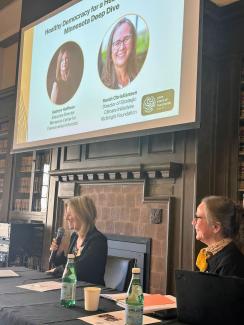
[From left to right]: Kathryn Hoffman, Executive Director of the Minnesota Center for Environmental Advocacy (MCEA) and Sarah Christiansen, Director of Strategic Climate Initiatives at the McKnight Foundation.
Kathryn offered critical insights into federal encroachment and the rush of data centers challenging the state. Minnesotan communities are still living on high alert, and the state has demonstrated unity and solidarity. Kathryn shared that Minnesota’s response to these challenges can serve as a model for the nation.
Minnesota is facing twenty five (25) hyper-scale data center proposals, with limited transparency into the process. Data centers contribute to a range of environmental impacts, including water use, energy consumption, and light pollution, which opposes Minnesota’s 2040 Clean Energy Plan.
Minnesotan communities are mobilizing without a central hub or leader and demonstrating a motto seen on banners throughout the Twin Cities: We keep us safe. Communities are turning to MCEA for support. MCEA is working on a dual strategy of litigation and legislation and believes this model can be replicated across the country.
Kathryn shared recommendations for grantmakers to support rapid response democracy work in their own regions. She amplified replicable models for funding Infrastructure to sustain change. This is one of the core principles from The Accords on the Future of Environmental Philanthropy. The Accords invites grantmakers to make funding flexible to enable organizations to respond in real time to challenges, while decreasing administrative and financial burdens for reporting.
Takeaways
- Evergreen collaboration: A strong network of nonprofits can break siloes and support responsive and impactful work across sectors over time.
- Fund the Fights, and the Cooperation: While cooperation is valuable, democracy requires people to confront authoritarianism and corporate power through litigation, a vital part of movement infrastructure.
- Fund for the Long Term: Support frontline work by giving unrestricted funds. Now is the time to make long-term commitments. Consider expanding grant terms so organizations have something to build on.
- Plan for Long Partnership: Our strategies should go beyond immediate response to encompass what comes next. Consider how you can build on the work that partners are doing to secure the health of both communities and our environment.
Unlocking the power of Narrative Strategy
Jill Tidman, Executive Director at the Redford Center, and Heather Fipps, Program Strategist at the Redford Center, facilitated an impactful session where grantmakers explored the significance of leveraging narrative strategy in their work.
Narrative strategy is the approach we take in a story; it’s how we use stories to make a change. Jill and Heather shared that philanthropy is combating a defeatist media narrative, and that narrative strategy is a way to elevate the critical work the sector is doing.
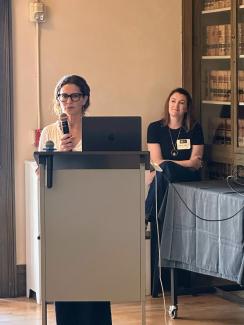
[From left to right]: Jill Tidman, Executive Director at the Redford Center, and Heather Fipps, Program Strategist at the Redford Center.
Additional readings and resources
- Explore The RedFord Center’s 2025 Annual Impact Report
Black Snow
- View the Case Study
- Watch the full film on PBS
Razing Liberty Square
- View the Case Study
- Watch the full film on PBS
Undamming Klamath
- View the Case Study
- Watch a 7-minute extended trailer on YouTube
Beyond the Briefing
Our closing session was facilitated by Sierra Martinez, the Senior Program Officer of Climate at the Clif Family Foundation.
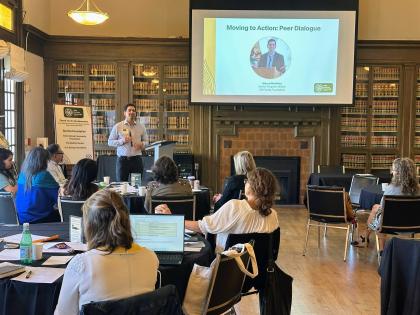
Sierra Martinez, the Senior Program Officer of Climate at the Clif Family Foundation.
Sierra grounded grantmakers in the day's learnings and offered closing thoughts that guided attendees on what philanthropy’s role is in advancing democracy and where we can learn from partners.
Save the Dates! 📅
2026 Fall Retreat in Virginia Beach, VA
Sept. 27-30, 2026